Fluid Mechanics:-
Mechanics is frequently asked in GATE and other PSU exams carrying medium marks weightage. Fluid statics comprises of topics Pascals Law, the pressure at a point and general equation for variation of pressure.
Fluid Statics:-
1. Fluid statics deals with problems associated with fluids at rest. The fluid can be either gaseous or liquid.
2. Fluid statics is generally referred to as hydrostatics when the fluid is a liquid and as aerostatics when the fluid is a gas.
3. The only stress we deal with in fluid statics is the normal stress, which is the pressure, and the variation of pressure is due to only the weight of the fluid. Therefore, the topic of fluid statics has significance only in gravity fields, and the force relations developed naturally involve the gravitational acceleration (g).
4. The force exerted on a surface by a fluid at rest is normal to the surface at the point of contact since there is no shear forces due to the absence of relative motion between the fluid and the solid surface.
5. The applications of fluid statics include the calculation of forces acting on floating or submerged bodies and the forces developed by devices like hydraulic presses and car jacks. The design of many engineering systems such as water dams and liquid storage tanks requires the determination of the forces acting on the surfaces using fluid statics.
Pressure
Pressure is defined as external normal force per unit area and its SI unit is N/m2 or Pascal (Pa).
Or
It is equal to the ratio of force applied over the area to be in contact.

Units of pressure
- 1Pascal= 1N/m2
- 1MPa= 1N/mm2
- 1bar= 105 Pascal=0.1N/mm2
- 1atm=101.325 kPa=0.101325 MPa
Types of pressure
1. Atmospheric pressure (Patm)
- Atmospheric pressure is the pressure exerted by environmental air.
- Atmospheric pressure is measure by a device known as barometer. It was invented by Torricelli.
2. Gauge Pressure (Pgauge)
- Gauge pressure is the pressure that is measured with respect to atmospheric pressure.
- Gauge Pressure can be positive (+ve) or Negative (-ve).
- Vacuum pressure (PVacuum) or pressures less than atmospheric are known as negative (-ve) gauge pressure.
3. Absolute pressure (Pabs)
- This is the pressures that is measured with respect to zero pressure line.
- Absolute pressure is always positive.
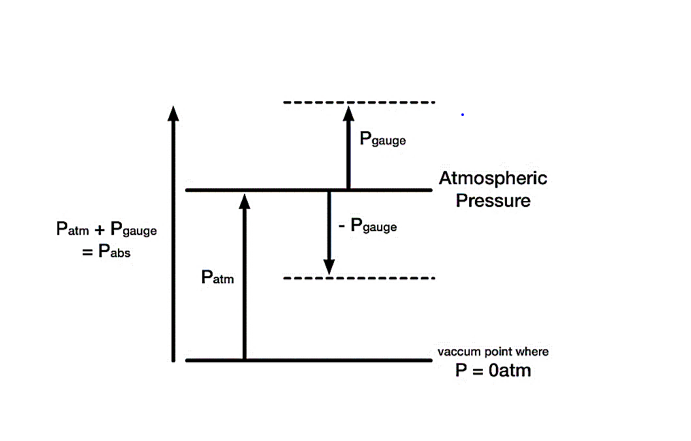 Note.1:
- For all numerical problems we have to find gauge pressure until and unless absolute pressure is asked.
- All the negative Gauge pressures are taken and considered with a negative sign.
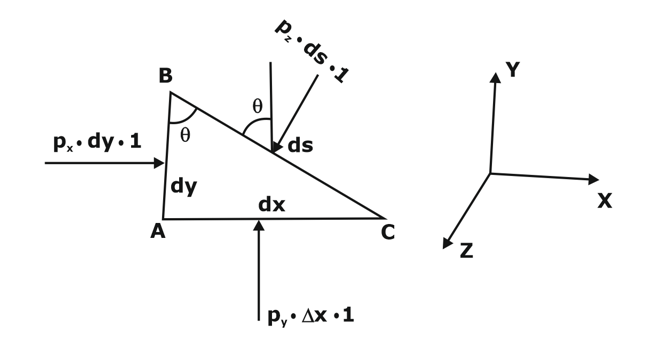
---It states that pressure or intensity of pressure at a point in a static fluid (fluid is in rest) is equal in all directions.
Or
---It states that the force exerted over the all contacted areas of the walls.




Comments
Post a Comment