
Strain

 STRAIN:-

  When a prismatic bar is subjected to axial load, it undergoes a change in length, as indicated in Figure. This change in length is usually called deformation.  

                                                            Or 

In simple terms the definition is

The strain is equal to the ratio of change in length of the body to the original length. 
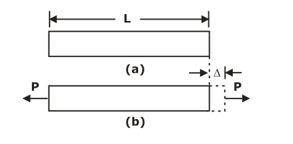
                                 

 If the axial force is tensile, the length of the bar is increased, while if the axial force is compressive, there is shortening of the length of the bar.

The deformation (i.e. elongation or shortening) per unit length of the bar is termed as strain and denoted by ε or e.

                         

Types of Strain: 

(i) Longitudinal strain:

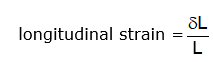
The ratio of axial deformation along the length of the applied load to the original length of the body is known as longitudinal (or linear) strain.

L = Length of the body,

P = Tensile force acting on the body,

δL = Increase in the length of the body in the direction of P.

Then,
                                    

(ii) Lateral strain:

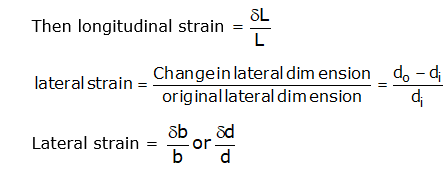
The strain at right angles to the direction of applied load is known as lateral strain. Let a rectangular bar of length L, breadth b and depth d is subjected to an axial tensile load P. The length of the bar with increase while the breadth and depth will decrease.

δL = Increase in length,

δb = Decrease in breadth, and

δd = Decrease in depth.


(iii). Shear Strain:-

Shear strain is the ratio of the change in deformation to its original length perpendicular to the axes of the member due to shear stress

Note:-Shear stress is stress in parallel to the cross section of the structural member.


Comments

Popular posts from this blog

  Force:-   It is defined as the acceleration to move the object from one position to another.                                                Or  The push or pull on an object with mass that causes it to change its velocity. Force is an external agent capable of changing the state of rest or motion of a body.                              Force = Mass × Acceleration                                  F = m × a Where, the terms are denoted by the follow...

Tissue

The Formation of Tissues Cells form groups cells that need to perform a single task often group together. This grouping of cells together to perform a function efficiently is called a  Tissue . For Example , Muscles and Blood. The tissue cells have the same structure and they perform the same function. Tissues of Plants and Animals Plant Tissues Animal Tissues Plants do not move so their tissues are predominantly the ones that provide support to them so that they can stand erect. Animals need more energy as compared to plants because they are not stationary. Their tissues are the ones that can support movement. These tissues are made up of dead cells because dead cells can also provide mechanical strength to the plants and do not require much maintenance. The tissues in case of animals are made up of living cells so that they can move and perform several functions. Only certain parts of the plant can grow. The tissues present in such regions of and divide themselves and form new ti...

Human Eye and the Colorful world

  HUMAN EYE : It acts like a camera, enable us to capture the colourful picture of the surroundings. An inverted, real image on light sensitive  is formed on the  Retina The Various Parts of Eye and their Functions 1. Cornea  : It is a thin membrane through which light enters. It forms the transparent bulge on the front of eyeball. Most of the refraction occurs at the outer surface of the cornea. 2.  Eyeball  :it is a convex lens, approximately spherical in shape, with a diameter of about 2.3 cm. It can alter its curvature with help of ciliary muscles. 3.  Iris : It is a dark muscular diaphragm that controls the size of pupil.It is behind the cornea.it helps in accommodation of light by changing the size of the pupil. 4.  Pupil  :It regulates and control the amount of light entering the eye. It is the black opening between aqueous humour& lens.BLack in colour. Light entering cannot exit. 5.  Crystalline eye lens  :Prov...