Thermodynamics:-
Thermodynamics comes from the Greek words therme (heat) and dynamic (power), so thermodynamics can be referred as the science in which study of the transfer of heat takes place.
Or
“Thermodynamics is the science of energy transfer & transformation and its effect on the physical properties of substance”.
SYSTEM-
A system is defined as a quantity of matter (control mass) or a region (control volume) in space chosen for study.
Or
A system is that region where the study is focused.

SURROUNDINGS-
Everything external to the system is called the surroundings or the environment.
All the energy interaction is studied between the system and surroundings i.e. all the energy leaving the system will be absorb by surrounding and removing.
BOUNDARY-
A real or imaginary surface that separates the system from its surroundings is called the boundary.
The boundary is the contact surface of system and surrounding thus shared by both the system and the surroundings. Mathematically, the boundary has zero thickness, and thus it can neither contain any mass nor occupy any volume in space. The boundary may be either fixed or moving.

Universe-
A system and its surroundings together comprise a universe.
Universe consist of everything, so everything happening whether energy transfer or transformation or losses remain inside universe.
TYPES OF SYSTEM-
(Depending upon the mass and energy interaction.)
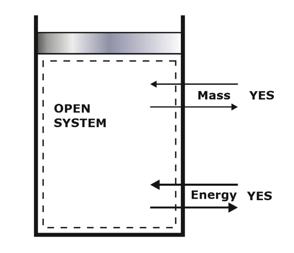
(i) Open System –
A system is said to be open system when there is mass as well as energy can transfer across the boundary. Example - Most of the engineering devices are generally open systems, air compressor, boiler, pump, IC engine with valve open etc.
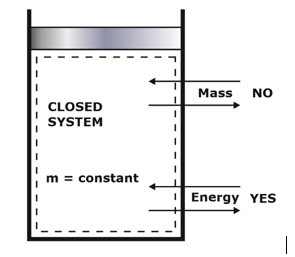
(ii) closed system –
A system is said to be closed system if its mass remains fixed or constant but there may be energy transfer into or out of the system i.e. there is no mass transfer across the system boundary. Example – a certain quantity of fluid in a completely enclosed cylinder, Tea in kettle, automobile engine with valve closed etc.
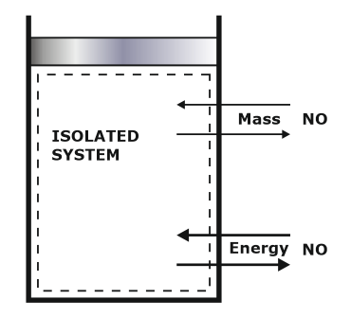
(iii) Isolated system -
A system is said to be isolated system when there is no mass and energy interaction between the system and the surroundings. It is of fixed mass and energy, and there is no mass or energy transfer across the system boundary. Example – thermo-flask, Universe (since all energy interaction taking place between systems and surrounding which is the part of universe)

MACROSCOPIC v/s MICROSCOPIC APPROACH
Macroscopic Approach -
In the macroscopic approach, a certain quantity of matter is considered, without molecular level being taken into account. It is also known as classical approach. All the properties will be the average of the properties of each molecule passing through that space.
Microscopic Approach -
From the microscopic point of view, matter is composed of numbers of molecules and study is made on molecular level. The behaviour of the gas is described by summing up the behaviour of each molecule.
CONCEPT OF CONTINUUM-
The concept of continuum is an idealization of the continuous description of matter where the properties of the matter are considered as continuous functions of space i.e. the space between the molecules (mean free path) is almost zero or very small as compare to the size of the system.
EXTENSIVE PROPERTIES v/s INTENSIVE PROPERTIES
(i) Extensive Properties – The properties which dependent on mass is known as extensive properties. As the mass of the specimen changes the value of extensive properties will also change. It is also known as Extrinsic properties.
Example – Volume, Enthalpy, Weight, All forms of energy etc.
(ii) Intensive Properties – extensive properties per unit mass, are intensive properties. These properties do not dependent of mass of the system. It is system property independent of quantity. It is also known as intrinsic properties.
Example – Temperature, Pressure, Density, Viscosity, Ratio of two extensive properties, specific energy, specific enthalpy etc.
THERMODYNAMIC EQUILIBRIUM
A system is said to exist in a state of thermodynamic equilibrium when no change in any macroscopic property is registered. A system will be in a state of thermodynamic equilibrium, if the conditions for the following three types of equilibrium are satisfied:
(i) Mechanical Equilibrium - In the absence of any unbalanced force within the system itself and also between the system and the surroundings.
(ii) Chemical equilibrium - If there is no chemical reaction or transfer of matter from one part of the system to another.
(iii) Thermal equilibrium - When a system existing in mechanical and chemical equilibrium is separated from its surroundings by a diathermic wall (diathermic means ‘which allows heat to flow’).
When the conditions for any one of the three types of equilibrium are not satisfied, a system is said to be in a non-equilibrium state.
Thermodynamic properties defined only for thermodynamic equilibrium states.
PROCESS -
Any change that a system undergoes from one equilibrium state to another equilibrium state is called a process.
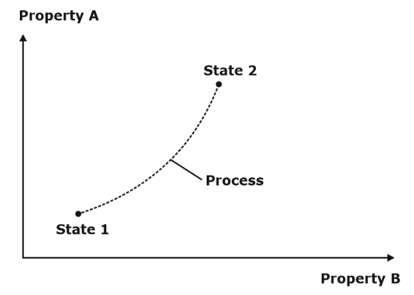
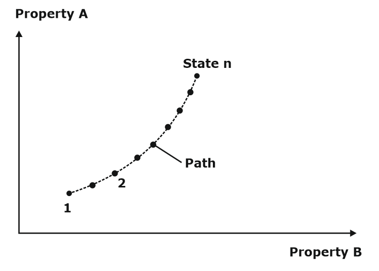
PATH -
The succession of states passed through during a change of state is called the path of the change of state.
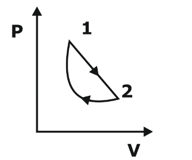
CYCLE -
A thermodynamic cycle is defined as a series of state changes such that the final state is identical with the initial state.
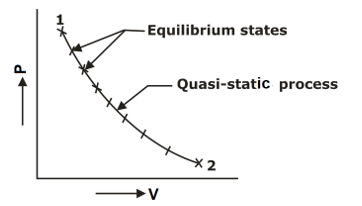
QUASI-STATIC PROCESS-
‘Quasi’ meaning ‘almost’ and ‘Static’ means ‘at rest’. Infinite slowness is the characteristic feature of a quasi-static process. Such a process, which is a locus of all the equilibrium states is known as a quasi-static process. In this process, every state of system passes through an equilibrium state.
It is an infinity slow process.
REVERSIBLE AND IRREVERSIBLE PROCESS
Reversible process are subset of Quasi static process. A reversible process is defined as a process that can be reversed without leaving any trace on the surroundings.
That is, both the system and the surroundings are returned to their initial states at the end of the reverse process without any change on system or surrounding.
While plotting the curve, reversible processes are shown by continuous line or curve whereas irreversible processes are shown by dotted line or curve.
Note:- Reversible processes actually do not occur in nature. They are merely idealizations of actual processes.
Irreversible Process:-
Processes that are not reversible are called irreversible processes.
PURE SUBSTANCE-
A pure substance is defined as one that is homogeneous and invariable in chemical composition throughout its mass. The relative proportions of the chemical elements constituting the substance are also constant.
Examples: Atmospheric air, steam-water mixture and combustion products of a fuel are regarded as pure substances.
IDEAL GAS EQUATION -
Ideal (perfect) gas equation is a special equation of state, which is applicable to ideal gases. The molecular forces of attraction between gas molecules are zero(almost), a gas is called a perfect gas.
The perfect or ideal gas equation of state is given by:
PV=nRT
Where:
P = Absolute Pressure = atmospheric pressure + Gauge pressure (in pascal)
V = Volume in m3
R= Universal Gas constant = 8.314KJ/Kmol-K
T = Absolute temperature in kelvin
n = number of moles (in k-mol)
Boyle’s Law- Boyle’s law states that when the temperature is kept constant, the volume of a given mass of gas varies inversely with the pressure.

Charles Law- Charles’s law, if the pressure remains constant then volume occupied by a fixed amount of gas is directly proportional to its absolute temperature.

Comments
Post a Comment